
Quick answer: Conservatory roof tiles are a great upgrade for most UK homeowners looking for year-round usability, better insulation, and lower energy bills. Tiled roofs achieve U-values of 0.15–0.18 W/m²K — about 20 times more thermally efficient than polycarbonate. However, before committing, a structural suitability survey is essential to ensure your conservatory can safely support the added weight.
Your conservatory has potential. The question is whether a tiled roof is the upgrade that unlocks it — or if another solution fits your needs better. Issues like temperature extremes, loud rain noise, and underused space can all be solved with the right approach. This guide will help you determine if conservatory roof tiles are the right answer for your situation.
What Are Conservatory Roof Tiles?
Conservatory roof tiles, often called a solid or warm roof, replace your existing polycarbonate or glass roof with a lightweight tiled structure featuring integrated insulation. The result is a solid ceiling that performs like the roof on your home.
Modern systems use lightweight synthetic tiles, such as Tapco SlateClad or Metrotile, rather than heavy natural materials. These tiles are specifically designed to fit on existing conservatory frames without requiring major structural reinforcement in most cases. The tiles sit on a timber or steel subframe with an insulated ceiling beneath, achieving U-values of 0.15–0.18 W/m²K. This thermal performance meets or exceeds the minimum required for a permanent extension under UK Building Regulations (0.18 W/m²K).
For more details on Building Regulations and conservatory exemptions, consult the official government guidance.
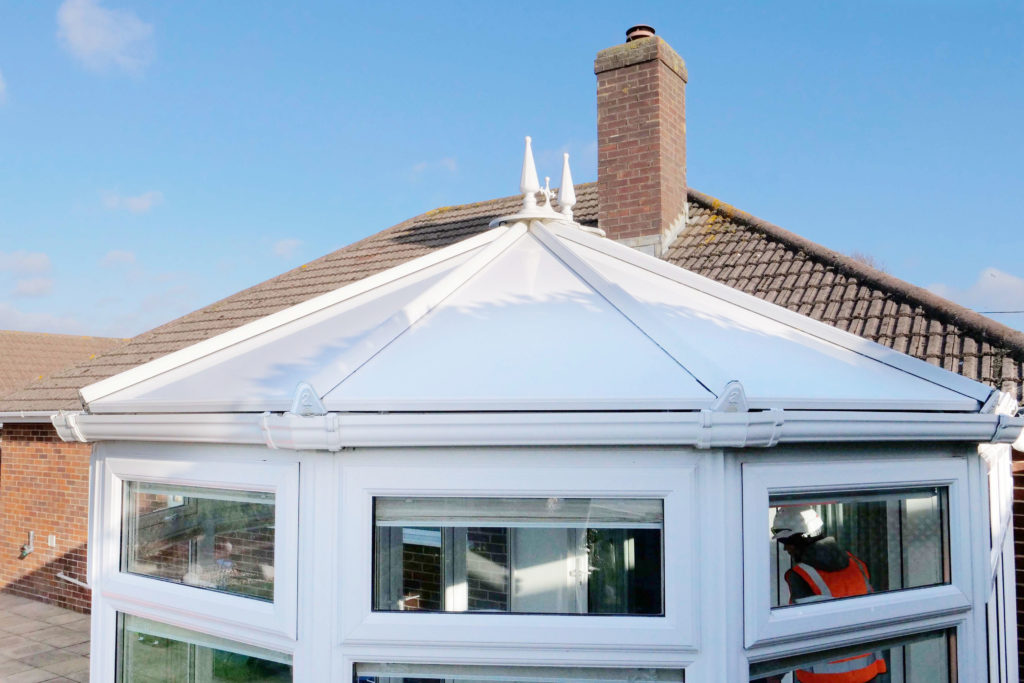
Roof Replacement Options
The three main conservatory roof options are:
Polycarbonate — Cheapest (£2,000–£6,500) but the least efficient (U-value ~3.0 W/m²K) and shortest lifespan (10–15 years).
Glass — Better insulation than polycarbonate, maximises light, but less efficient than tiles (U-value 1.0–1.6 W/m²K).
Tiled/Solid — Most thermally efficient (U-value 0.15–0.18 W/m²K), quietest, and longest-lasting (40–50+ years), at a higher cost (£6,000–£15,000).
For additional cost breakdowns and comparisons, see Checkatrade’s guide on conservatory roof replacement costs.
When Does a Tiled Roof Make Sense?
A tiled conservatory roof is the right choice in several situations. Here’s how to know if it’s the right move for you:
You want year-round usability.
A polycarbonate roof makes your conservatory too cold in winter and too hot in summer. A tiled roof solves both issues — retaining heat in winter and blocking solar gain in summer.
You plan to stay in your home for years.
The energy savings, comfort improvements, and added property value make sense over time. A tiled roof can save a typical UK home £300–£500 per year in heating costs (Roof2Room, 2026).
You’re preparing your home for sale.
A properly insulated conservatory, with a completion certificate from Building Control, is often treated as habitable floor space by estate agents. A well-converted conservatory can add 5–10% to your property value, according to RoofQuik (2025).
Your current roof is failing.
Yellowing, leaking polycarbonate or glass roofs near the end of their lifespan (10–15 years) are worth upgrading. The added cost for tiles delivers significant performance improvements.
Noise is a problem.
Rain noise on polycarbonate can make the space unusable for work or relaxation. A tiled roof, with its insulation and tile mass, absorbs impact noise, making the room silent even in heavy rain. Learn more about how rain noise varies by material in this BRE research paper: Rain Noise in Roof Constructions.
When a Tiled Roof Might Not Be the Right Move
Tiles aren’t for every conservatory. Here are situations where you might reconsider:
Your conservatory needs structural work.
Frames or foundations requiring reinforcement can sharply increase costs. A structural suitability survey, as recommended in LABC guidance, is essential before proceeding.
Natural light is your top priority.
A solid roof reduces daylight. Hybrid options, such as tiles with roof windows, may strike a better balance.
You only use the conservatory seasonally.
If spring-through-autumn usability is enough, a polycarbonate replacement may suffice at a lower cost.
You plan to sell soon.
If selling within 12 months, the cost and disruption of a tiled roof may not be recovered.
Why a Structural Survey Matters
Upgrading to a tiled roof adds weight to your conservatory’s frame and foundations. Lightweight tiles minimise this, but older structures may still need reinforcement. Per LABC guidelines, structural checks must examine:
- Frame condition and foundation depth
- Roof design complexity
- Compliance with Building Regulations
- A structural survey should be included with any reputable installer’s quote.
- Costs and Installer Questions
Tiled conservatory roofs cost £6,000–£15,000 in the UK, depending on size, structural condition, and materials. To compare regional costs, see MyBuilder’s cost guide and Federation of Master Builders’ page. Before committing, be sure to ask:
Are you FMB or TrustMark certified?
Does the quote include a structural survey?
What U-value will the new roof achieve? (Should be 0.18 W/m²K or better.)
Who handles the Building Regulations application?
Get at least two quotes and clarify warranties and disposal costs for old materials.
For a summary of Building Regulations and exemptions, see the official UK guidance.